Indian conversation about air pollution is almost entirely about outdoor air — stubble
burning, traffic, construction, the winter AQI. All of it real. But it leaves out something
that happens in every home, twice a day, a few feet from where people are standing.
Cooking is a significant source of indoor fine particulate. This is well established in the
research literature and almost entirely absent from consumer conversation — partly because it
is uncomfortable, and partly because no brand has an obvious interest in raising it.
It deserves saying clearly: this is not an argument against Indian cooking.
It is an argument for the extractor fan above it, and for understanding when your indoor air is
worst — which, on many days, is not when the outdoor AQI is highest.
The uncomfortable finding: for a household that cooks daily with high-heat
techniques, kitchen air during and after cooking can be worse than the outdoor air the whole
city is worried about.
What Happens When You Cook
Three separate processes generate particulate, and most Indian cooking runs all three at
once.
Oil aerosolisation
Heat oil sufficiently and it does not merely get hot — it releases fine droplets and
breakdown products into the air. The hotter the oil and the longer it is held there, the more
is released. Deep-frying and tempering are the clearest examples.
Thermal breakdown of food
Browning, charring and roasting break organic material down into volatile compounds and fine
particles. This is the same chemistry that produces the aromas — the smell of food cooking is airborne material reaching you.
Combustion from the burner
An LPG flame is combustion occurring inside your kitchen. It produces nitrogen dioxide and
ultrafine particulate independently of the food, and it does so the entire time the hob is
lit.
Which Techniques Spike Air the Most
Technique
Why it emits
Relative impact
Tadka / chhaunk
Oil taken to very high heat, spices added — rapid aerosolisation
Sharp, intense spike
Deep-frying (puri, pakora, samosa)
Large volume of oil, sustained high temperature
Highest sustained
Roti on open flame
Direct charring plus the burner’s own combustion
High, repeated per roti
Dry-roasting spices
Thermal breakdown without oil
Moderate, brief
Tawa shallow-frying
Moderate oil, moderate heat, long duration
Moderate but prolonged
Pressure cooking / boiling
Steam, minimal aerosol; burner emissions only
Low
The pattern is consistent: heat plus oil plus open air is what emits. A
covered pressure cooker is a quiet appliance in air-quality terms. An open kadhai at frying
temperature is not.
The Gas Flame Itself
Separate from what you are cooking, the burner is its own source. Gas combustion in an
unvented indoor space produces nitrogen dioxide and ultrafine particles, and in a small kitchen
with the door closed and no extraction, these accumulate for as long as the flame is lit.
This is the strongest air-quality argument for induction, and it is worth stating precisely:
induction removes the burner’s emissions entirely. It does not reduce the particulate
produced by the food itself — hot oil aerosolises the same way on an induction hob. Switching
helps; it does not solve.
How Long It Lingers
Visible smoke clears quickly and is misleading. Fine particulate — the fraction small enough
to reach deep into the lungs — stays airborne far longer, and in a kitchen without effective
extraction can remain elevated for an hour or more after the hob is off.
Two practical consequences follow, and they are the most actionable things in this
article:
Turn the extractor on before you start, not when smoke appears. By the
time you can see it, dispersal has already begun.
Leave it running for 10–15 minutes after you finish. Switching it off
with the hob leaves the longest-lived fraction in the room.
There is also a layout consideration. Open-plan kitchens — increasingly common in Indian
apartments — remove the wall that used to contain cooking emissions. The living room now shares
the kitchen’s air, which makes source extraction considerably more important than it was in a
closed kitchen.
What Actually Reduces It
A properly sized chimney, used every time. Extraction at source beats
filtration after dispersal, decisively. The most common failures are a chimney too small for
the hob, ducting that is too long or too convoluted, and — most often — simply not switching
it on for “quick” cooking.
Clean the chimney filters. A grease-clogged baffle drastically reduces
extraction. This is the chimney equivalent of never changing a water filter.
Cross-ventilate while cooking, when outdoor air permits it. On a severe
AQI day this trade becomes genuinely difficult, and extraction plus a closed kitchen door is
the better option.
Close the kitchen door if you have one, to contain emissions rather than
letting them reach bedrooms.
Filter what escapes. An air purifier in an adjoining living area handles
the fraction that got past the chimney. In an open-plan home this is the realistic use case —
but it is second to extraction, not a substitute for it.
If you do one thing
Switch the chimney on before the oil goes in, and leave it running ten minutes after you finish. It costs nothing and addresses the source
directly.
A Word Against Panic
It would be easy to read this as an argument that Indian cooking is dangerous. It is not,
and we would rather not join the long tradition of brands selling appliances through fear.
People have cooked this way for a very long time. What has changed is the context: kitchens
are smaller and better sealed, open-plan layouts share kitchen air with living space, ambient
outdoor levels are already elevated, and more homes are cooking with the windows shut for more
of the year.
The reasonable response is not to change how you cook. It is to extract properly, ventilate
when the outdoor air allows, and know that the hour after dinner is when your indoor air is at
its worst — which is useful information whether or not you ever buy an appliance for it.
The same logic applies under your sink as above your hob — deal with the source, and
know what you are actually dealing with.
Yes, and substantially. High-heat techniques central to Indian cooking — tempering spices in hot oil, deep-frying, dry-roasting, and cooking roti directly on a flame — aerosolise oil and organic material into fine particulate. Indoor PM2.5 during and after cooking commonly rises well above the level in the same kitchen an hour later.
Is a kitchen chimney better than an air purifier for cooking smoke?
For cooking specifically, yes — and it is not close. A chimney captures at the source, before particles disperse into the room. An air purifier can only filter what has already spread. They are complementary rather than alternatives: extract at the hob, filter what escapes.
Does tadka cause air pollution indoors?
Tempering spices in hot oil is one of the sharper particulate events in a home kitchen. Oil is taken to a high temperature and spices are added, aerosolising oil droplets and organic compounds within seconds. The spike is brief and pronounced — which is exactly why running the extractor before you start matters more than switching it on afterwards.
Is a gas stove worse than induction for indoor air?
For air quality, yes. A gas flame is combustion happening in your kitchen, producing nitrogen dioxide and fine particulate in addition to whatever the food produces. Induction heats the pan without combustion, so it eliminates the burner’s own emissions — though it does not reduce the particulate from the cooking itself.
How long does cooking smoke stay in the air?
Longer than people expect. Visible smoke clears in minutes, but fine particulate can remain elevated for an hour or more in a poorly ventilated kitchen. The practical implication is that the extractor should keep running well after cooking ends, not be switched off with the hob.
Yes — with conditions that matter more than the brand you buy.
An air purifier with a genuine HEPA filter, running in a closed room it is
actually sized for, will measurably reduce fine particulate matter (PM2.5) in that
room. That part is not in serious dispute. It is straightforward physics: push air through a
fine enough filter often enough, and particle counts fall.
What is oversold is almost everything around that sentence. Most disappointment with air
purifiers in India comes from three failures, and none of them is the filter’s fault:
The room is open. A purifier competing with an open window or door is
filtering the outdoors, and it will lose.
The unit is too small for the space. This is the single most common
error, and we cover it in detail below.
The filter was never changed. A saturated HEPA filter is a restriction,
not a purifier.
The honest framing: an air purifier is a device that cleans the air in
one closed room. It is not a device that cleans the air you breathe. Those are different
things, and the gap between them is where most of the money is wasted.
What the Evidence Actually Shows
It is worth separating two questions that marketing tends to blur together.
Question 1: Do they reduce indoor particulate levels?
Consistently, yes. This is the well-established part. Studies measuring PM2.5 before and
after introducing HEPA filtration into homes find substantial reductions — commonly in the
range of 50–80% in a closed room, depending on the unit’s capacity relative to the room, how
long it has been running, and how much outdoor air is leaking in. You can verify this yourself
with a consumer PM2.5 monitor in an afternoon.
Question 2: Do they make you measurably healthier?
Here the evidence is real but weaker, and any brand claiming otherwise is overreaching.
Controlled trials have found short-term improvements in intermediate markers — blood pressure
and some markers of inflammation among them — when participants used HEPA filtration at home.
Studies in people with asthma and allergies have generally found symptom improvements,
particularly where indoor allergens are a significant trigger.
What has not been established is the thing buyers most want to know: that owning an
air purifier changes long-term health outcomes. The trials are typically small, short, and
measure proxies rather than disease. That is not evidence the devices do nothing — it is
evidence that the research needed to prove the bigger claim is hard to do and largely has not
been done.
How to read the claims
“Reduces PM2.5 by 99.97%” describes the filter, tested on a
single pass in a lab. It does not describe your room. A filter that removes 99.97% of
particles from the air passing through it will still leave a badly polluted room badly
polluted if it cannot move enough of that room’s air per hour.
Five Things an Air Purifier Cannot Do
It cannot clean air you are not in. Purifiers work per room. One unit
does not treat a flat.
It cannot beat an open window. On a high-AQI day, an open window
supplies polluted air far faster than any domestic unit can clean it.
It cannot remove gases without activated carbon. HEPA captures
particles. Odours, VOCs and cooking fumes need a carbon stage — and a thin carbon mesh
saturates within months.
It cannot improve ventilation. It does not add oxygen or remove carbon
dioxide. A sealed room with a running purifier still gets stuffy, because stuffiness is
a CO2 and humidity problem, not a particle problem.
It cannot help with dust already on surfaces. Only airborne particles
pass through the filter. Settled dust needs cleaning.
Why Most Indian Homes Get No Benefit
If there is one section of this guide worth acting on, it is this one. Sizing is where
almost every purchase goes wrong, and it goes wrong in a predictable direction: the unit is
too small.
The number that matters is CADR — Clean Air Delivery Rate — usually quoted
in cubic metres per hour (m³/h). It tells you how much genuinely clean air the unit delivers,
combining filter efficiency and fan capacity into one figure. A high-efficiency filter behind a
weak fan produces a low CADR, and a low CADR cannot protect a large room no matter what the
filter is rated at.
The second number is ACH — air changes per hour — how many times the unit
can process the room’s entire volume in an hour. For ordinary comfort, 2–3 ACH is often quoted.
For meaningful protection during a genuine pollution episode, or for someone with asthma, aim for around 5 ACH.
Working out what you actually need
Calculate your room’s volume, then multiply by the air changes you want:
Room
Approx. volume
CADR for 3 ACH
CADR for 5 ACH
Small bedroom — 10 x 10 ft
~28 m³
85 m³/h
140 m³/h
Standard bedroom — 12 x 12 ft
~41 m³
125 m³/h
205 m³/h
Large bedroom — 14 x 16 ft
~64 m³
190 m³/h
320 m³/h
Living room — 16 x 20 ft
~91 m³
275 m³/h
455 m³/h
Volumes assume a standard 10 ft ceiling. Measure yours — a 12 ft ceiling adds 20%.
Now compare that against the box. Manufacturers quote a coverage area,
and they are entitled to calculate it at a low air-change rate. A unit advertised for
“up to 400 sq ft” may be rated at around 2 ACH. In a genuine Delhi winter, that
same unit is honestly a 150–200 sq ft device. This is the gap that makes people conclude air
purifiers do not work.
The practical rule: take the coverage area printed on the box and
treat the unit as suitable for roughly half of it. If that still covers your room, the
sizing is genuinely adequate.
HEPA, CADR, ACH — What the Numbers Mean
HEPA grades, and the word that should worry you
True HEPA is a defined standard, not a marketing adjective. Under the European EN 1822
classification, H13 captures at least 99.95% and H14 at least
99.995% of particles at the most-penetrating size (around 0.3 microns — the hardest size to
catch; both larger and smaller particles are captured more easily).
The phrase to be wary of is “HEPA-type”, along with
“HEPA-style” and “99% HEPA”. These are not HEPA. They describe a filter
that resembles one and is not held to the standard. If a listing will not state a grade,
assume it does not have one.
The stages, and which ones earn their place
Stage
What it does
Worth paying for?
Pre-filter
Catches hair, lint and large dust; protects the HEPA behind it
Yes — and washable ones cut running costs
True HEPA (H13/H14)
The actual particulate removal — PM2.5, pollen, dust, smoke
Yes. This is the product
Activated carbon
Odours, VOCs, cooking and traffic fumes
Only if it is a substantial bed, not a thin sheet
UV lamp
Claims to kill captured organisms
Rarely — contact time inside a moving airstream is very short
Ioniser
Charges particles so they clump and settle
No — see below
The Running Cost Nobody Mentions
The purchase price is the smaller number. Filters are the real cost of ownership, and they
are the reason so many purifiers quietly stop working in year two.
A HEPA filter is consumed as it works. In Delhi-NCR winter conditions, a filter rated for a
year of “normal” use can saturate in a season. Budget realistically for
replacements, and check the filter price before buying the unit — some inexpensive
purifiers are sold on the printer-cartridge model, where the filters cost more over three years
than the machine did.
Electricity is the smaller line. Most domestic units draw somewhere between 20W and 60W
on typical settings — running one continuously usually costs less per month than the filters
amortised over the year.
Before you buy
Find the replacement filter’s price and its rated life. Multiply by three years and add it
to the purchase price. That is the number to compare across brands — not the sticker.
The One Type to Avoid
Any device sold as an ozone generator, or an “activated oxygen”
purifier, should be avoided for occupied rooms. Ozone is a respiratory irritant. Deliberately
generating it in a space where people are breathing trades a particle problem for a gas
problem.
Ionisers are a milder version of the same concern. They work by charging
particles so they clump and fall out of the air — which lowers what a sensor measures without
removing anything from the room; the particles are now on your surfaces. Some ionisers also
produce ozone as a by-product. An ioniser as a switchable extra on an otherwise good HEPA unit
is not a scandal — just leave it off. An ioniser sold as the purification method is a
different product from what you think you are buying.
Do You Actually Need One?
A Straight Decision Path
Step 1: Will the room be closed while it runs?
If the room cannot be kept closed — open kitchen, constant
through-traffic, windows open for ventilation — a purifier will not deliver.
Fix that first, or pick a different room.
Step 2: Does anyone in the house have asthma, allergies, or a
respiratory condition? Is there a baby or an elderly parent at home?
If yes, the case is strong — this is the group
where measured symptom benefits are most consistent. Size for 5 ACH, not 3.
Step 3: Does your city have a genuine seasonal pollution
problem?
Across the Indo-Gangetic plain — Delhi-NCR, and much of UP, Punjab,
Haryana and Bihar — winter PM2.5 routinely reaches levels where indoor filtration is a
reasonable response. Elsewhere, judge by your own local readings, not by
national headlines.
Step 4: Will you actually replace the filters?
Be honest. If the answer is no, the money is better not
spent — a neglected purifier is furniture.
Where a purifier is genuinely the wrong answer
Damp and mould. Filtering spores does not address the water causing
them. Fix the damp.
A stuffy, crowded room. That is CO2. It needs fresh air.
Persistent cooking smoke. An extractor at the source beats a purifier
across the room.
Outdoor exposure. If most of your day is spent commuting or outside,
a home purifier addresses the smaller share of your exposure.
Different problem, same principle: the fix depends on what is actually in your
supply. Check your area’s water quality from government data before buying any
purifier.
Yes, for particulate pollution — but conditionally. A correctly sized HEPA purifier running in a closed room measurably reduces PM2.5, typically by 50–80% within an hour. The conditions matter more than the brand: the room must be closed, the unit must be rated for that room’s size, and the filter must be replaced on schedule. Fail any one of those and the benefit largely disappears.
Do air purifiers help with Delhi’s winter pollution?
Indoors, yes. On a day when Delhi’s outdoor AQI is 400, indoor levels in a closed room with a correctly sized purifier can be brought down substantially. But the purifier does nothing for the time you spend outdoors, commuting, or with windows open — which for most people is where the majority of exposure happens. Treat it as reducing one part of your exposure, not solving it.
Is an air purifier worth it, or is it a waste of money?
It is worth it if you will keep the room closed and replace filters on time. It is a waste of money if you buy a unit rated for a small bedroom and run it in an open-plan hall, or if you stop changing filters after the first year — which is what most buyers do. The purifier is not the expense; the filters are.
What size air purifier do I need for my room?
Match CADR to room size, not brand claims. A practical rule adapted from AHAM: the CADR in cubic metres per hour should be roughly 5 times your room’s volume for meaningful protection in polluted conditions. For a 12 x 12 ft room with a 10 ft ceiling (about 41 m³), that means a CADR near 200 m³/h. Manufacturers usually quote a coverage area measured at a lower air-change rate, so the room it truly handles is smaller than the box says.
Do air purifiers remove viruses and bacteria?
A true HEPA filter captures particles in the size range that carries viruses and bacteria, so it does reduce their airborne concentration. It does not sterilise a room, does not stop close-range transmission, and is not a substitute for ventilation. Filtration and fresh air do different jobs.
Do air purifiers reduce carbon dioxide or make a room stuffy?
No — and this is a common misunderstanding. An air purifier recirculates and filters the air already in the room. It does not add oxygen or remove CO2. In a sealed room with people in it, CO2 will keep rising whether the purifier runs or not. That is a ventilation problem, and it needs fresh air, not filtration.
The Real Question Isn’t Which Technology — It’s Your Water
The internet is full of articles comparing UF, NF, and RO like they’re competing products on a spec sheet. Pore size. Operating pressure. Filtration accuracy. These comparisons are technically correct but practically useless — because the right technology depends entirely on what’s in your water, not on which membrane sounds most advanced.
Here’s what actually matters:
Is your TDS consistently low? Then you don’t need a pressure membrane at all. UF handles it with zero water wastage.
Is your TDS high or unpredictable? Then you need RO — the only technology that reliably brings dissolved solids down to safe levels.
What about NF? It sits in between, and that’s precisely the problem. It wastes water like a pressure-membrane system but doesn’t reduce TDS thoroughly enough for genuinely high-TDS water.
Before you read another word of this article, do one thing: test your water’s TDS. A TDS meter costs ₹200–500. That single number will tell you more about which purifier you need than any comparison chart ever will.
The one-line answer: If your TDS is consistently good (under 200 ppm), go UF. If your TDS needs to come down or fluctuates seasonally, go RO. NF is a compromise that rarely makes sense for Indian households.
UF (Ultrafiltration) — Zero Waste, Works When TDS Is Already Good
How It Works
UF uses a hollow-fibre membrane with pores around 0.01 microns. Water passes through under gravity or low pressure — no electricity, no pump, no reject water. The membrane physically blocks anything larger than its pore size: bacteria, cysts, sediment, rust particles, and other suspended contaminants.
What UF Removes
Bacteria: E. coli, Salmonella, Cholera bacteria — physically blocked and removed, not just killed.
Cysts and protozoa: Giardia, Cryptosporidium — too large to pass through UF pores.
Larger parasites: Worm eggs, amoeba, other macro-organisms.
What UF Cannot Do
Cannot remove dissolved solids. TDS passes through unchanged. If your input is 400 ppm, your output is 400 ppm.
Cannot remove most viruses. Many waterborne viruses (0.02–0.3 microns) are smaller than UF pore sizes.
Cannot remove dissolved chemicals. Pesticides, fluoride, nitrate, heavy metals — all pass through freely.
UF Verdict
Best choice when your water is already clean. If you have treated municipal supply with TDS consistently under 200 ppm and no known chemical contamination — UF gives you bacterial safety with zero water wastage, zero electricity, and very low maintenance. The membrane lasts 18–24 months. No other technology matches this efficiency for good-quality source water.
NF (Nanofiltration) — The Middle Ground That Doesn’t Quite Work
How It Works
NF uses a membrane with pores around 0.001 microns — ten times finer than UF, but ten times coarser than RO. Like RO, it requires a pump and water pressure to force water through the membrane. Like RO, it produces reject water. But unlike RO, it’s selective about what it removes.
What NF Removes
Hardness ions: Calcium, magnesium, and other divalent ions — this is NF’s primary strength. It softens water effectively.
Bacteria and most viruses: Physically blocked by the tighter membrane.
Some organic compounds: Pesticides, colour, natural organic matter.
Partial TDS reduction: Removes roughly 40–60% of dissolved solids — primarily the larger, multivalent ions.
What NF Cannot Do
Cannot fully reduce TDS. Monovalent ions like sodium, chloride, and potassium pass through NF membranes largely unchanged. If your water has 800 ppm TDS, NF might bring it to 400–500 ppm — better, but not where it needs to be.
Cannot remove heavy metals reliably. Lead, arsenic, and chromium — which are monovalent or form complexes that NF struggles with — may pass through at unsafe levels.
Still wastes water. NF rejects 500 ml to 2 litres for every litre purified. Less than RO, but still significant compared to UF’s zero wastage.
The NF Problem in Plain Language
NF gives you the downsides of a pressure-membrane system (water wastage, electricity needed, pump maintenance) without the upside that justifies those costs (thorough TDS reduction). If your water is good enough for NF, it’s probably good enough for UF — which wastes no water at all. If your water genuinely needs TDS reduction, NF doesn’t reduce it enough. You end up paying the “membrane tax” without getting your money’s worth.
NF Verdict
Not recommended for most Indian households. NF occupies an awkward middle ground. It’s marketed as “better than RO” because it retains minerals and wastes less water — but it also can’t handle the high-TDS, heavy-metal-laden water that most Indian homes actually deal with. If your water is genuinely low-TDS, UF does the job without any water wastage. If your water needs serious filtration, RO does it properly. NF solves a problem that most Indian water sources don’t have — moderately elevated hardness with otherwise clean water.
RO (Reverse Osmosis) — The Only Option When TDS Must Come Down
How It Works
RO forces water through a semi-permeable membrane with pores as small as 0.0001 microns — the tightest filtration available for household use. At this scale, only water molecules pass through. Everything else — dissolved salts, heavy metals, nitrate, fluoride, arsenic, pesticide residues — gets left behind and flushed out as reject water.
What RO Removes
Dissolved solids (TDS): Reduces TDS by 90–99%. The only household technology that meaningfully and reliably lowers TDS.
Heavy metals: Lead, mercury, cadmium, arsenic, chromium — all reduced to safe levels.
Chemical contaminants: Nitrate, fluoride, sulphate, chloride — including monovalent ions that NF lets through.
Bacteria and viruses: Physically too large to pass through the RO membrane.
What RO Cannot Do
It strips essential minerals. Calcium, magnesium, and potassium are removed along with harmful contaminants. This is why a post-RO mineraliser is critical — it adds back essential minerals to make water healthy, not just clean.
It wastes water. Traditional RO systems reject 60–70% of input water. Modern high-recovery systems bring this to 40–50%, but some wastage is inherent to the technology.
It needs electricity and water pressure. No power means no purification.
Why RO Is Essential for Sensitive Users
For infants, young children, pregnant women, elderly family members, and anyone with kidney or immune system conditions, RO provides a level of safety that UF and NF cannot match. These groups are disproportionately affected by dissolved contaminants — heavy metals that accumulate over time, nitrate that affects oxygen transport in infants, fluoride that impacts developing bones. When the stakes are higher, thorough filtration isn’t optional.
RO Verdict
The definitive choice when TDS needs to come down. If your water has TDS above 300 ppm — which covers most of Delhi, Gurgaon, Hyderabad, Chennai, and any borewell-fed area — RO is non-negotiable. Yes, it wastes water. Yes, it costs more to maintain. But it’s the only technology that actually removes the dissolved contaminants making your water unsafe. The water wastage is the price of thorough purification. For sensitive users — children, patients, elderly — RO provides a margin of safety that no other technology can.
UF vs NF vs RO — Side-by-Side Comparison
Parameter
UF
NF
RO
Pore size
0.01 microns
0.001 microns
0.0001 microns
TDS reduction
None (0%)
Partial (40–60%)
Near-complete (90–99%)
Removes bacteria?
Yes (physically blocked)
Yes (physically blocked)
Yes (physically blocked)
Removes viruses?
No (too small)
Yes (most)
Yes
Removes heavy metals?
No
Partially (unreliable)
Yes (90–99%)
Removes hardness?
No
Yes (primary strength)
Yes
Water wastage
Zero
500 ml–2 L per litre
2–4 L per litre
Needs electricity?
No
Yes (pump required)
Yes (pump required)
Retains minerals?
Yes (all pass through)
Partially (keeps monovalent)
No (needs mineraliser)
Ideal TDS range
Under 200 ppm
200–500 ppm (limited use)
300–2000+ ppm
Membrane life
18–24 months
12–18 months
12–24 months
Best suited for
Good municipal supply
Moderately hard, low-TDS water
High TDS, borewell, tanker, sensitive users
The Water Wastage Reality Check
Water wastage is the number-one argument used to sell NF over RO. Let’s break down what the numbers actually mean for a typical Indian household.
Daily Water Consumption: 15 Litres (Family of 4)
Technology
Water Needed (Input)
Water Wasted Daily
Water Wasted Monthly
UF
15 L
0 L
0 L
NF
22–30 L
7–15 L
210–450 L
RO (traditional)
45–50 L
30–35 L
900–1050 L
RO (modern high-recovery)
25–30 L
10–15 L
300–450 L
The real comparison: Modern high-recovery RO systems waste roughly the same amount of water as NF — around 300–450 litres per month. The gap between NF and modern RO is far smaller than NF marketing suggests. And UF, at zero waste, beats both by a margin no membrane system can match. If water conservation is your priority and your TDS allows it, UF is the clear winner — not NF.
Cost: They’re Closer Than You Think
One of the biggest misconceptions is that these three technologies sit in vastly different price brackets. In reality, the upfront cost of a quality UF, NF, or RO purifier is remarkably similar — most land in the ₹10,000–₹25,000 range. The cost differences show up in maintenance and running costs over time, but even those are closer than marketing would have you believe.
3-Year Total Cost of Ownership
Cost Component
UF
NF
RO
Purifier cost
₹8,000–₹18,000
₹12,000–₹22,000
₹10,000–₹25,000
Annual maintenance
₹1,000–₹2,000
₹2,500–₹4,000
₹3,000–₹5,000
Electricity (annual)
₹0
₹600–₹1,200
₹800–₹1,500
Water cost (annual)
₹0
₹300–₹600
₹400–₹1,200
3-year total
₹11,000–₹24,000
₹22,200–₹39,400
₹22,600–₹48,100
The point isn’t that one technology is “cheap” and another is “expensive.” They’re all in the same ballpark. The point is that cost should not drive your technology choice. Your water quality should. If you buy UF to save money but your water has 600 ppm TDS, you’ve saved ₹10,000 and gained nothing — those dissolved contaminants pass straight through. If you buy RO when your water is already at 120 ppm, you’re wasting water and money on a problem that doesn’t exist.
The Bottom Line on Cost
Since the cost is similar across all three, the deciding factor should always be your water quality — not the price tag. A ₹15,000 UF purifier on good water outperforms a ₹25,000 NF purifier on the same water. And a ₹20,000 RO purifier on high-TDS water is worth every rupee — because no cheaper technology can do what it does.
Which Technology Do You Actually Need?
Forget the spec sheets. Answer two questions about your water, and the right technology becomes obvious.
Your Decision Tree
Question 1: What is your water’s TDS?
Use a TDS meter (₹200–500). Under 200 ppm consistently → UF is your answer. Above 300 ppm → you need RO. Between 200–300 ppm → proceed to Question 2.
Question 2: Does your water quality stay consistent year-round?
Consistent TDS, no seasonal variation, treated municipal supply → UF works. TDS fluctuates between seasons, you use borewell water part-time, or monsoon affects your supply → go with RO. Seasonal variation means your purifier must handle the worst case, not the average.
Are there sensitive users in your home?
Infants, young children, pregnant women, elderly, or anyone with kidney or immune conditions? Choose RO regardless of TDS reading. These groups need the extra margin of safety against dissolved contaminants that TDS meters don’t fully capture — heavy metals, nitrate, pesticide traces.
Where Does NF Fit?
In theory, NF works for a very narrow scenario: water with moderate hardness (200–500 ppm), no heavy metal contamination, consistent quality year-round, and no sensitive users in the household. In practice, this describes very few Indian water sources. Most homes that fit this profile would be equally well-served by UF (if their TDS is at the lower end) or RO (if they want the safety margin).
4 Mistakes Buyers Make With NF Purifiers
1. Assuming “Less Water Waste” Means “Better Technology”
NF wastes less water than traditional RO — true. But modern high-recovery RO systems have closed most of that gap. And UF wastes zero water. Comparing NF only against old-generation RO creates a misleading picture. The real comparison should include UF (which beats NF on wastage) and modern RO (which comes close to NF on wastage while far exceeding it on purification).
2. Believing “Retains Minerals” Is Always an Advantage
NF retains monovalent minerals — sodium, potassium, chloride — that pass through its membrane. This is marketed as “healthier water.” But if your source water has elevated sodium or chloride levels (common in coastal and groundwater-fed areas), retaining these isn’t a benefit — it’s a problem. RO removes everything and then adds back only the beneficial minerals through a mineraliser. That’s more controlled and more reliable than NF’s passive “let some through” approach.
3. Using NF for Borewell Water
Borewell water in India typically has TDS between 500–2000+ ppm, with dissolved iron, fluoride, arsenic, and nitrate. NF’s 40–60% TDS reduction brings 800 ppm water down to maybe 400 ppm — still well above the 300 ppm safe threshold. Worse, many of the dangerous contaminants in borewell water (arsenic, fluoride, nitrate) are monovalent or small enough to pass through NF membranes. RO is the only safe option for borewell water.
4. Not Testing Water Before Choosing
The single most expensive mistake: buying a purifier based on technology marketing instead of your actual water quality. A ₹200 TDS meter would have told you whether you need UF, NF, or RO — but you spent ₹20,000 on the wrong technology because the brochure looked convincing. Test first. Buy second. Always.
Not sure what’s in your water? Boon offers free water quality testing with every consultation.
Boon doesn’t sell UF purifiers, NF purifiers, or “basic RO” purifiers as separate product lines — because the goal isn’t to sell you a membrane type. The goal is to give you water that’s genuinely safe for your family, matched to your actual water source.
8-Stage UltraOsmosis — RO+UV+UF in One System
Boon Homie uses an 8-stage filtration system that combines RO, UV, and UF together — each technology handling what it does best:
RO membrane: Handles dissolved solids, heavy metals, fluoride, nitrate, arsenic. Rated for up to 2000 ppm input TDS.
UF membrane: Physical barrier that catches bacteria and cysts as an additional safety layer.
UV disinfection: Kills any remaining viruses and microorganisms.
Mineraliser + Carbon Polish: Adds back calcium and magnesium, removes any residual taste or odour.
WaterAI: Know Your Water Quality in Real Time
Instead of guessing whether your water needs RO or UF, WaterAI shows you exactly what’s in your water — input TDS, output TDS, and filter performance — in real time on your phone. You see when filters need replacement based on actual degradation, not a calendar. This alone can save ₹2,000–₹4,000 per year by preventing premature filter changes while ensuring you never drink through a degraded filter.
60 Litres Per Hour
Most purifiers deliver 15–20 litres per hour. For a family of 4–6 using purified water for drinking, cooking, and rinsing produce, that means waiting during peak hours. Boon Homie purifies at 60 LPH — fast enough that you never run dry, even with heavy usage.
It depends on your water’s TDS. If your TDS is consistently below 200 ppm (good municipal supply), UF is the best choice — zero water wastage, no electricity needed, and it removes bacteria and suspended particles effectively. If your TDS is above 300 ppm or fluctuates seasonally, RO is the only technology that reduces dissolved solids reliably. NF sits in the middle but isn’t ideal for most situations — it wastes water like RO but only reduces TDS by 40–60%, which may not be enough for high-TDS water.
Does nanofiltration waste water like RO?
Yes, NF does waste water. NF purifiers reject approximately 500 ml to 2 litres for every litre of purified water. While this is less than traditional RO systems (which reject 3–4 litres per litre purified), it’s still significant compared to UF, which has zero water wastage. This is a key drawback — you get the water wastage of a pressure-membrane system without the thorough TDS reduction that RO provides.
Can nanofiltration replace RO for high TDS water?
No. Nanofiltration reduces TDS by only 40–60%, primarily removing divalent ions like calcium and magnesium (hardness). It lets most monovalent ions like sodium and chloride pass through. For water with TDS above 500 ppm — common in Delhi, Gurgaon, Hyderabad, and borewell-fed areas — NF cannot bring TDS down to safe drinking levels. RO reduces TDS by 90–99% and is the only household technology capable of handling high-TDS water effectively.
Is UF water purifier safe for drinking?
Yes, UF is safe when your source water has low TDS (under 200 ppm) and no dissolved chemical contaminants like heavy metals, fluoride, or nitrate. UF physically removes bacteria, cysts, and suspended particles through a 0.01-micron membrane — without electricity or water wastage. However, UF cannot remove dissolved solids or most viruses. It works best with treated municipal water that has consistent, low TDS. If your water quality fluctuates or comes from borewells, UF alone is not sufficient.
What is the cost difference between UF, NF, and RO?
Surprisingly small. Most quality units fall in the ₹10,000–₹25,000 range regardless of technology. The real cost difference is in ongoing maintenance and water wastage. UF has the lowest running cost (no electricity, no water waste). NF sits in the middle. RO has the highest running cost but also the most thorough purification. Since the cost is similar, let your water quality drive the decision, not the price tag.
The right purifier starts with knowing your water. Get a free water quality test and expert recommendation from Boon.
The short answer: an under sink RO water purifier is a reverse-osmosis system that lives inside the cabinet below your kitchen sink and sends purified water to a small dedicated tap on the counter. In India, a good one costs ₹12,000–35,000, needs roughly 50 cm of free cabinet width (or a wall inside the cabinet), one hole in the counter for the tap (24 mm for Boon Tap), a cold-water line, a drain and a power socket. Installation takes under two hours. The purification is the same as a wall-mounted RO; only the location changes.
What Is an Under-Sink RO Water Purifier?
An under-sink water purifier is a purification system installed inside the cabinet beneath your kitchen sink, out of sight. Instead of sitting on the counter or hanging on a wall, the whole unit — filters, RO membrane, storage tank and tubing — lives behind the cabinet door.
Purified water comes out of a dedicated tap mounted on the countertop, separate from your main kitchen mixer. Flick the tap, clean water flows. The purifier does its work below — no visible box, no blinking lights, nothing on the counter except the tap itself.
Under-sink RO has been the default in North American and European kitchens for decades. In India, where wall-mounted purifiers dominated for twenty years, the shift is recent and it is being driven by modular kitchens: integrated cabinetry is designed to hide appliances, and a plastic box on the wall is the one thing in the room that doesn’t belong. Modern under sink RO water purifiers are now slim enough to fit a standard Indian sink cabinet, which is what makes the format practical rather than aspirational.
If you are building or renovating a kitchen in 2026, under-sink should be your default, not the exception. The rest of this guide covers what it needs from your kitchen, what it costs, and what to check before you buy. (Still deciding between formats? Start with our under-sink vs countertop comparison.)
The under-sink purifier this guide is built around
Municipal, low-TDS water? Boon Tap UF keeps the minerals and sends nothing to the drain — ₹18,500.
Under-Sink vs Wall-Mounted vs Countertop: Which Setup Is Right for You?
Most buyers in India default to wall-mounted because that is what they have always seen. The right choice depends on your kitchen layout, how much you care about the look, and whether you can drill the counter. Here is an honest comparison:
Factor
Under-Sink
Wall-Mounted
Countertop
Visibility
Hidden; only a slim tap shows
Fully visible on the wall
Sits on the counter, always visible
Counter Space Used
Zero (one tap)
None, but takes wall space
30–40 cm of counter
Cabinet Space Used
Part of the sink cabinet
None
None
Kitchen Aesthetics
Best — clean, clutter-free
Moderate — a box on the wall
Poorest — bulk on the counter
Installation
One counter hole, drain saddle, socket in cabinet
Wall drilling, basic plumbing
Plug and play
Filter Access
Open the cabinet door, front access
Easy — at eye level
Easiest — right there
Typical Price Range
₹12,000 – ₹35,000
₹7,000 – ₹30,000
₹5,000 – ₹15,000
Best For
Modular kitchens, design-led homes, rentals where drilling is allowed
Kitchens with free wall space near the sink
Rentals where nothing can be drilled, temporary setups
The short version: if you have a modular kitchen or are building one, under-sink wins on looks and space. If you rent and cannot drill the countertop, wall-mounted or countertop is more practical. Purification quality is identical across all three — it is the same RO / UV / UF technology wherever the unit sits.
Will It Fit? Cabinet Measurements That Matter
This is the single most common mistake under-sink buyers make: the purifier arrives, the technician opens the cabinet, and it doesn’t fit — or fits so tightly the filters can’t be reached. Five minutes with a tape measure prevents it.
What to measure
Usable width — between the cabinet side walls, minus the space taken by the drain trap and inlet pipes.
Usable depth — from the front edge of the cabinet to the back wall. Pipes and the stopcock usually sit against the back wall, so measure in front of them.
Usable height — from the cabinet floor to the lowest point of the sink bowl, not the counter. A deep single-bowl sink can drop 20–25 cm below the counter.
What already lives there — the bin, the dishwasher inlet, cleaning supplies. The purifier and tank need their own space, and the filters need clear room in front of the unit for changes.
The actual numbers, using Boon Tap as the reference
Generic guides give you a vague “40 × 35 × 50 cm”. Here are real dimensions from the Boon Tap specification sheet, so you can lay them against your own cabinet:
Component
Size
What it means for your cabinet
Purification unit
47.0 × 11.0 × 35.5 cm (L × B × H)
Only 11 cm deep — it stands flat against the back or side wall of the cabinet, or mounts on the wall.
Pressure tank (8 L)
24.7 cm diameter × 33.1 cm tall
Sits on the cabinet floor beside or in front of the unit; allow ~5 cm above it for the fitting.
Both, side by side
~75 cm wide × 25 cm deep × 40 cm tall
Fits a standard 90 cm sink cabinet with room to spare.
Both, tank in front of unit
~50 cm wide × 40 cm deep × 40 cm tall
Fits a 60 cm sink cabinet. This is the usual layout in Indian modular kitchens.
Tap on the counter
One 24 mm hole
See the tap-hole section below.
If the cabinet is shallow or already full, you are not out of options. Because the Boon Tap unit is thin, it installs three ways: unit and tank together inside the cabinet; unit wall-mounted with the tank below it; or unit and tank both wall-mounted, stacked, which frees the cabinet floor entirely. The technician picks the configuration on the day based on what your cabinet allows.
Rule of thumb
If you can clear a 50 cm wide × 40 cm deep × 40 cm tall block on the cabinet floor, or free a stretch of wall inside the cabinet, an under-sink RO will fit. Most 60 cm and 90 cm Indian sink cabinets clear this easily once the bin moves.
Tap Hole Size for an Under-Sink Purifier
The purified-water tap needs its own hole in the countertop or sink deck. The size depends on the tap you buy, so check before anyone drills:
Boon Tap needs a 24 mm hole. The tap has a weighted metal base and a solid SS 304 body, so the hole is larger than the 12 mm many basic plastic RO faucets use. Do not let a plumber drill for a “standard RO tap” without checking.
The hole your kitchen mixer uses is too big. Kitchen mixers usually sit in a ~35 mm hole. A purifier tap in that hole needs an adaptor plate, so use a fresh hole rather than an unused mixer hole where possible.
Where to put it: beside the mixer, on the side you fill bottles and pots from, with enough clearance behind for the tap’s base and the tubing underneath. Boon Tap swivels 360°, so it reaches both bowls of a double sink from one position.
Granite and quartz are drilled with a diamond core bit in 10–15 minutes. A steel sink deck is drilled with a hole punch or step bit. Both are routine for a trained installer — Boon’s technician does it as part of the free installation. If you are paying a plumber separately, expect ₹200–500 for stone.
Renting? Ask the landlord before drilling. Many agree once they see it is a single, clean 24 mm hole next to the mixer, not a wall full of brackets.
What to Look for in an Under-Sink RO Water Purifier
The core technology is the same as any RO. The under-sink context adds a few things most buying guides skip, because the unit is hidden and you cannot see it working.
1. Tank size, and knowing the level without opening the door
On a wall-mounted purifier you watch the tank drop and plan around it. Hidden under the sink, that cue is gone. So the two things that matter are:
A tank sized for your household. The tank is the buffer that covers peak demand while the membrane refills. A family of four typically draws 12–15 litres a day, with 4–6 litres going in a single morning or evening rush. An 8-litre tank covers that; a 5-litre one leaves you waiting at the tap. The tank matters more than the litres-per-hour figure, because you drink from the tank, not straight from the membrane.
A way to see status without opening the cabinet. A display on the unit helps; an app on your phone is better. It should show filter health, live TDS and alerts, so a hidden tank never catches you out mid-cooking.
2. Filter change access
Filters get changed every 12–24 months depending on the unit and your water. In a cabinet, the technician needs to reach the filter housings from the front with enough clearance to pull each cartridge out. Front-loading designs are far easier to service under a sink than top-loading ones, where the sink bowl is directly above the filter. Long filter life helps too: a system rated for up to two years between changes means far fewer visits into the cabinet.
3. Leak protection
A leak on a wall unit runs visibly down the wall. A leak under the sink can go unnoticed for days, swelling the cabinet base and starting mould. Look for good push-fit connectors rather than compression fittings, a unit that flags faults on a display or in an app, and put a shallow tray under the tank as cheap insurance.
4. Input TDS rating
Your input water’s TDS decides which membrane you need. Most residential RO membranes handle up to 2,000 PPM. In parts of Delhi NCR, Gurgaon and Rajasthan, borewell TDS runs past 1,500 PPM, so confirm the rating. Not sure of your number? Look it up in our city-wise water quality & TDS checker.
Also check how the purifier puts minerals back. A mineraliser adds calcium and magnesium after RO; a TDS controller blends some unpurified water back in. The mineraliser approach is safer because nothing bypasses the membrane — we break it down in TDS controller vs mineraliser.
5. Water wastage ratio
Every RO produces reject water. Under a sink the reject line runs straight into the drain, so it is easy to forget it exists. Standard RO rejects about 3 litres per litre purified (25% recovery); efficient units do 1:2 or better. Check the figure before buying, and see our tips to reduce RO water wastage by routing reject water to mopping or plants.
6. Who installs it, and what that costs
Under-sink installation involves drilling the counter, tapping the cold line, clamping a drain saddle and testing every joint. Some brands charge for this or hand you to a third-party plumber. Ask whether installation, the pre-filter and the tap are included, and who comes if something leaks in month three.
Under-Sink RO Price in India (2026)
Under-sink RO purifiers in India sell in three bands. The sticker price is only part of the picture — filters, service and AMC over the years usually cost as much again.
Band
Price
What you typically get
Budget
₹12,000 – ₹16,000
Basic RO, plastic tap, 5–6 L tank, no monitoring, paid installation, yearly AMC pushed at sale.
Mid-range
₹18,000 – ₹25,000
Multi-stage RO with mineral enhancement, 8 L tank, steel tap, app monitoring, free installation, 2-year warranty. Boon Tap (₹20,990) and Boon Tap UF (₹18,500) sit here.
Premium / imported
₹28,000 – ₹35,000+
Imported systems, often without India-tuned membranes or a local service network. Filters can be hard to source.
The number that matters: cost over four years
Take a mid-range unit at ₹20,990 with a two-year warranty and filters that last up to two years. Over four years you pay the purchase price plus one full filter set at ₹4,000 — about ₹25,000 all in. A cheaper unit with a ₹7,500 yearly filter-and-AMC bill costs ₹30,000 in filters alone over the same four years, before you count the purifier. Free installation is worth another ₹1,000–2,000 against a unit that charges for the plumber, the drilling and the pre-filter. Read our true cost of owning a water purifier before you decide on price alone.
RO or UF Under the Sink?
Not every kitchen needs RO. The decision is your input water’s TDS:
Above roughly 500 PPM (borewell, tanker, mixed supply, most of NCR, Rajasthan, parts of Bengaluru and Hyderabad): you need RO. It removes dissolved salts and heavy metals a UF membrane cannot.
Below about 300 PPM (treated municipal supply in much of Mumbai, Pune, Kolkata and the hill cities): UF is the better under-sink choice. It removes bacteria, cysts and turbidity, keeps the natural minerals, and sends no water to the drain.
In between: check the water rather than guess. Municipal supply can swing with the season, and a TDS meter costs a few hundred rupees.
Boon Tap comes in both: Boon Tap RO for high-TDS water and Boon Tap UF for low-TDS municipal supply, on the same unit, tank and tap. For the technology itself, see RO vs UV vs UF.
Installation: What to Expect
Under-sink installation is more involved than wall-mounting, but not complicated for a trained technician. Here is what a proper job looks like.
What the kitchen needs
Cold water line — the purifier taps into the existing cold supply under the sink with a T-connector. No new plumbing line.
Drain connection — the reject line clamps onto the sink’s drain pipe with a drain saddle. The pipe is not cut or replaced.
The tap hole — one hole in the counter (24 mm for Boon Tap), drilled on the day.
A power socket inside the cabinet — RO needs electricity for the pump and UV. Most modular kitchens have a socket under the sink; if yours doesn’t, an electrician adds one for under ₹1,000. Do not run an extension cord into a cabinet with water in it.
How long it takes
A competent technician finishes an under-sink RO installation in 60–90 minutes; Boon quotes under two hours including drilling the counter, flushing the system and walking you through the display and app.
What a good installer checks
Input TDS before starting, to confirm the membrane suits your water.
Inlet pressure — the purifier needs steady pressure to run. Boon Tap runs its own pump (you can see its status in the app), so low mains pressure is not a blocker.
A leak test at every joint after 10 minutes of running, checked dry-handed.
Output TDS, measured and shown to you. RO output is typically 30–80 PPM before mineral enhancement.
Free flow on the reject line — a kinked drain line shortens membrane life.
The pre-filter matters more than you think
A sediment pre-filter ahead of the unit catches sand, rust and pipe debris before it reaches the RO membrane — and in Indian cities, especially after pipeline work or during the monsoon, there is plenty of it. Make sure one is included and fitted; Boon includes it free with every system.
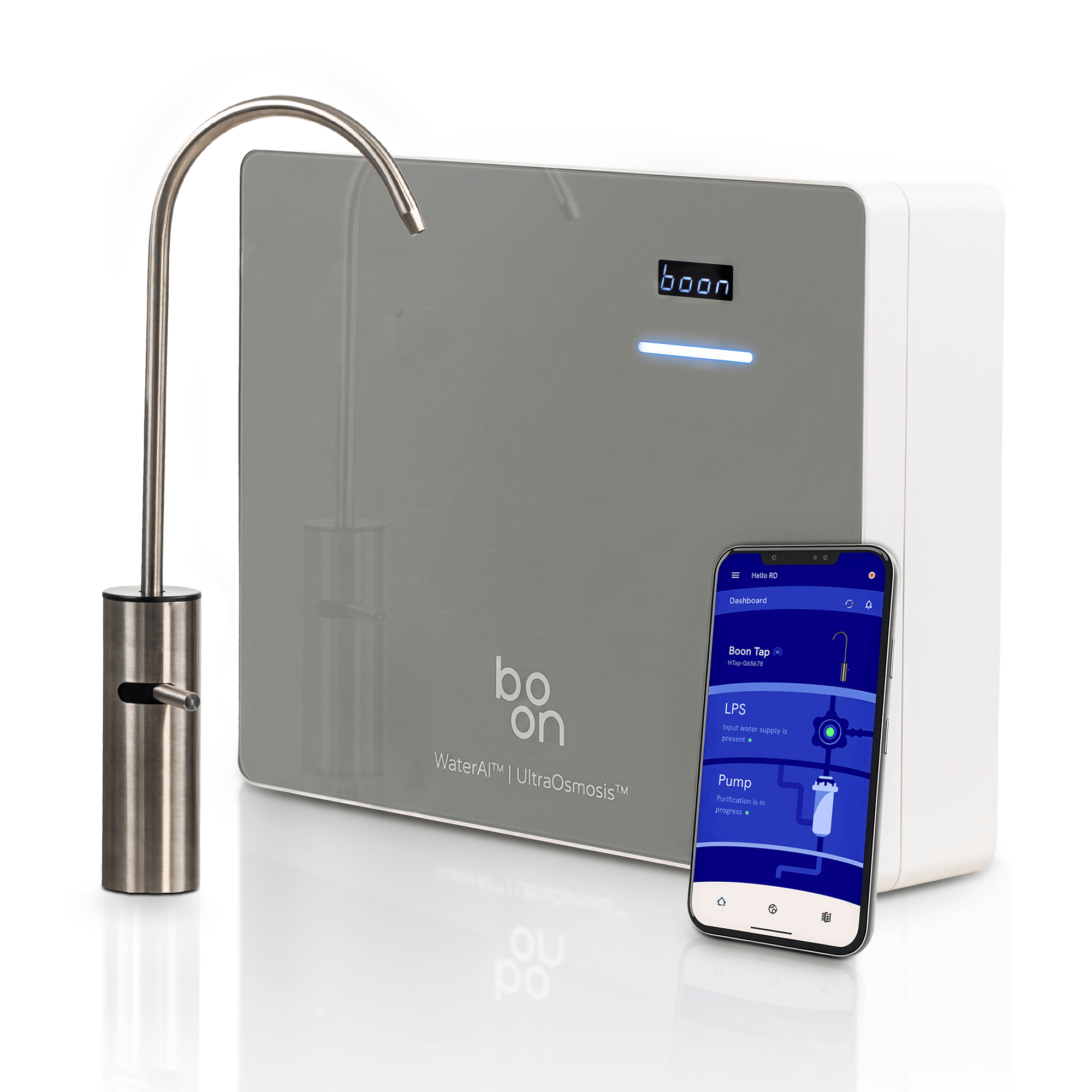
Boon Tap was built around one idea: the purifier you don’t have to look at. The unit and tank hide inside the cabinet; the only thing on the counter is a solid stainless-steel tap. It is the reference product in this guide because it solves the specific problems an under-sink buyer has, not just the general ones.
Slim enough to fit, three ways to install
The purification unit is 11 cm deep with a glass front, so it stands flat against a cabinet wall or mounts on it. Together with the 8-litre tank it fits a standard 60 cm sink cabinet; if your cabinet is spoken for, the unit and tank wall-mount, stacked or side by side. The same purchase works whatever your kitchen allows.
A tap you will actually want on show
Because the tap is the only visible part, Boon Tap comes in three finishes — Gunmetal Grey, Matte Black and Soul Silver. It is milled from SS 304 with a weighted metal base, a 360° swivel and a one-touch toggle, and it needs a 24 mm hole in the counter.
You always know what a hidden unit is doing
This is the feature that matters most under a sink. The unit itself carries a digit display and a colour-coded LED alert bar, so one glance inside the cabinet shows live TDS and status. The WaterAI™ app goes further: real-time TDS, flow and water quality, predictive filter-health alerts based on your actual usage rather than a fixed six-month timer, and an Away mode that flushes the system every 24 hours while you travel. The WaterAI app won an iF Design Award 2026. Wi-Fi is only needed for the app; the tap and display work fully offline.
8-stage UltraOsmosis™, RO or UF, 8-litre tank
Boon Tap runs 8-stage UltraOsmosis™ purification — grooved sediment and carbon pre-filtration, the RO membrane with anti-scale protection, natural mineral enhancement and a mirrored UV chamber — handling input TDS up to 2,000 PPM, with an 8-litre pressurised tank and a 20 LPH membrane behind it. Three Water Profiles (Daily, Active, Brew) tune the mineral dose after RO; nothing bypasses the membrane. Choose RO for borewell and high-TDS supply, or the UF variant for low-TDS municipal water. Read more about UltraOsmosis™ and WaterAI™.
Free installation by Boon’s own technicians, and no AMC
Boon-certified technicians install it free, usually in under two hours: they measure the cabinet, choose the configuration, drill the 24 mm tap hole, route the plumbing, fit the free pre-filter, leak-test every joint and measure output TDS before leaving. Boon Tap carries a 2-year warranty with filters rated for up to two years; after that there is no AMC — a full filter set is ₹4,000, and you pay only for the part you need. There is a 10-day money-back guarantee on every unit. The full terms are on the warranty and maintenance page.
Why Boon Tap works under a sink: it was designed to be hidden in the first place; a display on the unit and the WaterAI™ app mean you always know the state of a tank you cannot see; the 8-litre buffer covers peak demand; three install configurations mean it fits kitchens where other under-sink units don’t; and free installation removes the drilling-and-drain complexity. See the Boon Tap under sink RO water purifier →
Common Mistakes to Avoid When Buying an Under-Sink RO Purifier
We see these repeatedly. Each one is avoidable with a little planning.
1. Not measuring the cabinet
The most common and most frustrating mistake. Measure usable width, depth and height (to the bottom of the sink bowl, not the counter) before you shortlist, and account for the pipes and the bin. The numbers in the fit section above are real ones to check against.
2. Drilling the wrong tap hole
A plumber who drills 12 mm for a “standard RO tap” leaves you with a hole that is too small for a steel tap like Boon’s (24 mm) — and stone cannot be un-drilled. Confirm the size for the specific tap, or let the brand’s installer drill it.
3. Ignoring the drain connection
The reject line needs a sound drain pipe to clamp onto. Old, brittle PVC or an awkwardly placed trap can make the saddle connection difficult. Have the technician look at the drain routing before installation day, not on it.
4. Wedging the unit where the filters can’t be reached
If the filter housings face the back wall, every service becomes an ordeal: pull the unit out, disconnect, replace, reconnect, leak-test again. Position it so the filters face the cabinet door with clearance to pull them out.
5. Chasing litres-per-hour instead of tank size and visibility
For a hidden unit, what protects you from waiting at the tap is a well-sized tank plus a way to see its status. A generous tank buffers peak demand while the membrane refills; a display or app tells you where things stand. That combination beats a big LPH number you cannot monitor.
6. Skipping the pre-filter
Without a sediment pre-filter, the membrane takes the full force of raw water — sand, rust, pipe debris. It clogs faster and dies sooner. A ₹200–400 pre-filter is the cheapest insurance there is; make sure it is fitted, not just in the box.
7. Not planning for power
Cabinets do not always have a socket. Running an extension cord into a cabinet with water in it is a hazard. Plan the outlet before the purifier arrives; it is a 30-minute job for an electrician.
Frequently Asked Questions
What is an under-sink RO water purifier?
An under-sink RO water purifier is a reverse osmosis system installed inside the cabinet beneath your kitchen sink. It connects to the cold water line, sends reject water to the sink drain, and dispenses purified water through a dedicated tap on the countertop. The purifier, tank and tubing stay hidden inside the cabinet. The purification technology is identical to wall-mounted or countertop RO; only the location differs.
How much space do I need under the sink for an RO purifier?
Roughly a 50 cm wide, 40 cm deep, 40 cm tall block of free space on the cabinet floor, or a free stretch of wall inside the cabinet. As a reference, the Boon Tap unit is 47 × 11 × 35.5 cm and its 8-litre tank is 24.7 cm across and 33.1 cm tall; together they fit a standard 60 cm Indian sink cabinet with the tank in front of the unit, or wall-mount if the floor is taken.
What size hole does an under-sink water purifier tap need?
It depends on the tap. Basic plastic RO faucets often use a 12 mm hole; a solid steel tap such as Boon Tap needs a 24 mm hole. The ~35 mm hole a kitchen mixer uses is too large without an adaptor plate. Confirm the size for your specific tap before anyone drills, because stone cannot be un-drilled. Boon’s technician drills the hole as part of the free installation.
How much does an under-sink RO water purifier cost in India?
Between ₹12,000 and ₹35,000 in 2026. Budget units start around ₹12,000 but usually charge for installation and push a yearly AMC. Mid-range units at ₹18,000–25,000 — Boon Tap is ₹20,990 and Boon Tap UF ₹18,500 — include installation, an 8-litre tank, app monitoring and a 2-year warranty. Over four years, filter costs matter as much as the sticker price: one ₹4,000 filter set versus ₹7,500 every year adds up to a ₹26,000 difference.
Can any RO water purifier be installed under the sink?
No. The unit must be compact enough to fit the cabinet with room to change filters, and it needs a storage tank sized for the household plus a way to know the tank level without seeing it. Units designed only for wall-mounting may have the wrong port orientation and drain routing for a cabinet. Confirm under-sink compatibility before buying.
Can an under-sink water purifier be wall-mounted instead?
Some can. Boon Tap installs three ways: unit and tank together in the cabinet, unit on the wall with the tank below, or unit and tank both wall-mounted and stacked. That flexibility matters in kitchens where the cabinet is shallow or already full.
Does an under-sink RO purifier need electricity?
Yes. The pump and UV stage run on mains power, so you need a socket inside or near the cabinet. If there isn’t one, an electrician can add it for under ₹1,000. Never run an extension cord into a cabinet that carries water.
How long does under-sink installation take?
60–90 minutes for a trained technician, including drilling the tap hole, connecting the cold line and drain, fitting the pre-filter, flushing the system and checking output TDS. Boon quotes under two hours and includes the installation free.
How do I know when to change filters if the purifier is hidden?
Choose a unit with a display on the purifier or, better, app monitoring that predicts filter life from your actual water and usage rather than a fixed six-month timer. Boon Tap shows status on an LED bar on the unit and sends filter-health alerts through the WaterAI™ app, so you never need to open the cabinet to check.
Does an under-sink RO purifier waste more water?
No. Wastage depends on the membrane’s recovery rate, not where the unit sits. A typical RO produces 1 litre of purified water for every 2–3 litres of input. Under a sink the drain connection is shorter and more direct, which if anything simplifies the plumbing. If your water is low in TDS, a UF unit sends nothing to the drain at all.
Boon Tap: 8-stage UltraOsmosis™ RO, an 8-litre tank, WaterAI™ monitoring, three tap finishes, three install configurations — ₹20,990, installed free, with a 2-year warranty and a 10-day money-back guarantee.
Most water purifier comparisons go something like this: someone lines up three brands, compares RO vs UV vs UF, checks the tank size, glances at the MRP, and picks the cheapest one that says “RO+UV” on the box.
This is how you end up spending more in the long run.
The actual differences between water purifier brands have very little to do with the spec sheet that shows up on an e-commerce listing. They’re in the things you only discover after six months of ownership: how quickly filters degrade, how much replacements actually cost, whether the technician who shows up knows what he’s doing, and whether your purifier can keep up with a family of five during dinner prep.
We built Boon because we saw these gaps firsthand — first in the 400+ hotels and commercial properties we serve across India, then in the homes of the people who worked at those hotels and asked if they could buy the same technology for their kitchens.
Industry Reality
The average Indian household spends 2–3x the sticker price of their water purifier over a 3-year ownership period. Filter replacements, AMC contracts, and service visit charges add up to more than the original purchase price — and most buyers don’t calculate this before buying.
Source: Boon internal research, 2025–2026
This article isn’t a typical “Brand X vs Brand Y” comparison. We’re not going to name competitors — you already know who they are. Instead, we’re going to show you what’s actually different about Boon versus the industry standard, category by category, with real numbers. You can decide whether those differences matter to you.
Filtration Technology: 4-Stage vs 8-Stage
Most water purifiers sold in India use 4 to 5 filtration stages. The typical configuration looks like this:
Sediment filter — removes sand, rust, and large particles
Pre-carbon filter — reduces chlorine and some organic compounds
RO membrane — removes dissolved solids, heavy metals, and salts
UV chamber — kills bacteria and viruses
Post-carbon or mineraliser — improves taste and adds back some minerals (not always present)
This configuration works. It will produce water that’s measurably cleaner than your input. For many households with moderate-TDS municipal water, it’s adequate.
Boon uses 8-stage UltraOsmosis — a filtration architecture we developed and hold 7 patents on. Here’s what the additional stages do:
Dedicated heavy metal adsorption stage — targets lead, mercury, and arsenic with a specialised media bed, rather than relying solely on the RO membrane to catch everything
Alkaline mineralisation — a controlled post-RO stage that adds calcium, magnesium, and potassium back into the water at precise concentrations, rather than using a TDS blender that mixes raw (unfiltered) water back in
Ultrafiltration polishing — a final physical barrier that catches anything the earlier stages might have missed, providing redundancy that matters when input water quality fluctuates
Why this matters: Indian water quality is not uniform. Your TDS can spike 200–300 ppm between seasons. Ammonia contamination events happen without warning. A 4-stage system works when conditions are predictable. An 8-stage system works when conditions aren’t — which, in India, is most of the time.
The difference isn’t just about having more stages for the sake of it. Each additional stage targets a specific contamination vector that a basic RO+UV configuration handles incompletely or not at all. If you want to understand the underlying technologies in detail, our RO vs UV vs UF guide breaks down how each filtration method works and when you need it.
Smart Monitoring vs Timed Indicators
Most water purifiers tell you when to change a filter using one of two methods:
LED indicator — a light turns red (or starts blinking) after a preset number of litres or days, regardless of actual filter condition
Timed reminder — the brand calls you every 6 or 12 months to schedule a filter replacement, regardless of whether the filter actually needs replacing
Both methods have the same problem: they don’t know what’s actually happening inside your purifier.
If your input water quality is better than average, you’re replacing filters before they need it — wasting money. If your input quality is worse than average (a Yamuna ammonia spike, monsoon contamination, a borewell switching on), you might be running degraded filters without knowing it — compromising safety.
Boon WaterAI: What It Actually Does
WaterAI is a real-time monitoring system built into every Boon purifier. It connects to your phone via the Boon app and tracks three things continuously:
Input water quality — TDS, turbidity, and contamination levels of the water entering your purifier, measured in real time
Output water quality — the same parameters for the water coming out, so you can verify your purifier is actually doing its job at any moment
Filter health — actual degradation state of each filter stage, based on throughput, quality differential, and usage patterns — not a simple timer
The result: you replace filters when they actually need replacing. Not before, not after. You get notified if input quality degrades suddenly. And you have a continuous record of your water quality that you can check any time.
Recognition: WaterAI won the iF Design Award 2026 — one of the world’s most respected design awards, recognising innovation in product design and user experience. It was recognised for making water quality data genuinely useful to consumers, not just decorative.
Is smart monitoring essential? No. Millions of homes run perfectly fine on timed filter replacements. But if you want to know — actually know — what’s in your water and when your filters are genuinely due, this is the only system in the Indian market that does it at this level.
Service Model: Outsourced vs In-House
This is the difference that doesn’t show up on any spec sheet, but it’s the one customers mention most often after 6–12 months of ownership.
Most water purifier brands in India outsource service. Here’s what that typically looks like:
The brand contracts with regional service partners or franchised service centres in each city
The technician who shows up is employed by the service partner, not the brand
Training quality varies between service partners
The brand has limited control over response time, parts quality, and customer experience
In smaller cities or newer localities, service coverage may be sparse or non-existent
This isn’t a criticism — it’s the economic reality of scaling a consumer appliance business across India. Outsourced service networks are cheaper and faster to deploy. But the trade-off is inconsistency. The technician who installs your purifier in South Delhi may be excellent. The one who services it in Gurgaon may not be.
How Boon Does It Differently
Boon employs its own service technicians. Not franchised. Not contracted. Employed — meaning salaried, trained by Boon, and accountable to Boon.
This means:
Every installation is done by a Boon employee, to a consistent standard
Every service call is handled by someone who knows the product inside out — not someone who services five different brands in a week
A free pre-filter is included with every installation — most brands charge separately for this, or skip it entirely
Parts are always genuine — no ambiguity about whether the replacement filter is original or third-party
We learned this from our B2B business. When you’re serving 400+ hotel clients — properties where water quality directly affects guest experience and health compliance — you cannot afford inconsistent service. Hotels don’t tolerate “the technician didn’t show up” or “the replacement filter wasn’t original.” That same standard applies to every home installation.
Why It Matters
Boon’s B2B portfolio includes 400+ hotel and commercial properties across India — from boutique hotels to large hospitality chains. The service infrastructure built for that scale is the same infrastructure that services every home customer. You’re not getting a home-appliance service experience. You’re getting a hospitality-grade service experience.
Total Cost of Ownership
This is where most brand comparisons fall apart — because most comparisons only look at MRP.
A water purifier is not a one-time purchase. Over three years, you’ll pay for filter replacements (typically 2–4 times), an annual maintenance contract, and potentially service visit charges. The brand that looks cheapest on day one often isn’t cheapest by year three.
Here’s a realistic 3-year cost breakdown comparing Boon against two typical market categories:
Cost Component
Typical Budget Brand
Typical Premium Brand
Boon Homie
MRP
~12,000
~22,000
~18,000
Installation
800–1,500
Free–1,000
Free (incl. pre-filter)
Annual filter replacements (x3 years)
6,000–9,000
6,000–8,000
5,000–7,000
AMC / service contract (x3 years)
3,000–6,000
4,000–8,000
3,500–5,000
Service visit charges
500–2,000
Free–1,500
Free (in-house team)
3-Year Total Cost
22,000–30,500
32,000–40,500
26,500–30,000
The numbers tell an interesting story. The budget brand that costs ₹10,000 less than Boon on day one? It closes that gap almost entirely within three years — and you’re getting 4-stage filtration instead of 8-stage UltraOsmosis with real-time monitoring. The premium brand that costs ₹4,000 more than Boon upfront? It pulls further ahead in TCO because of higher AMC costs and expensive proprietary filters.
Boon sits in a deliberate sweet spot: premium technology at a mid-range total cost of ownership. Not the cheapest option on day one. But consistently one of the most cost-effective options over the ownership period that actually matters.
Deep dive: For a detailed breakdown of how to calculate your own water purifier’s 3-year cost — including hidden charges most brands don’t mention upfront — read our True Cost of Owning a Water Purifier guide.
The Verdict: When to Choose Boon (and When Another Brand Might Work)
We’re going to be honest here, because we’d rather have the right customers than all the customers.
Choose Boon If:
Your input TDS is above 300 ppm — Boon’s 8-stage UltraOsmosis is engineered for challenging water. If your water is already clean, you’re over-engineering the solution.
You care about long-term cost, not just sticker price — if you’re comparing 3-year TCO, Boon is competitive with or better than most alternatives.
You want to know what’s in your water — WaterAI gives you real-time data that no other brand in India currently offers at the consumer level.
Consistent service quality matters to you — in-house technicians, every time, no exceptions.
Another Brand Might Work If:
Your TDS is consistently below 200 ppm — in areas with excellent municipal water (parts of Mumbai, Chandigarh), a basic UV+UF purifier may genuinely be sufficient. You don’t need 8-stage filtration for water that’s already clean.
You’re on a strict budget under ₹10,000 — Boon isn’t the cheapest purifier on the market, and we’re not going to pretend otherwise. If upfront cost is the primary constraint, there are BIS-certified options that will get the job done at a lower price point.
You’re a single person or couple with low daily consumption — if you’re purifying 5–8 litres a day, the advanced filtration and monitoring capabilities are less critical.
The best water purifier brand in India isn’t a universal answer. It depends on your water, your household, your budget, and what you value. What we can tell you is exactly what Boon offers, at exactly what cost, with exactly what trade-offs. The decision is yours.
If you’re still narrowing down your options, our Best Water Purifier in India 2026 guide covers the full landscape — technologies, price ranges, and what to look for regardless of which brand you choose.
What makes Boon different from other water purifier brands in India?
Three things: 8-stage UltraOsmosis filtration backed by 7 patents (vs the industry-standard 4–5 stages), real-time WaterAI monitoring via app (iF Design Award 2026 winner), and a fully in-house service team — no outsourced technicians. Boon also serves 400+ hotel clients with the same technology it puts in homes.
Is Boon worth the higher price compared to other water purifiers?
When you compare 3-year total cost of ownership — not just MRP — Boon is often competitive with or cheaper than brands that appear affordable upfront. A typical budget purifier at ₹12,000 MRP can cost ₹22,000–30,000 over three years after filter replacements, AMC, and service charges. Boon’s 3-year TCO is approximately ₹26,500–30,000, with significantly better filtration, faster speed, and free installation including pre-filter. Read the full cost comparison here.
How many filtration stages do most water purifiers have?
Most water purifiers sold in India use 4 to 5 stages: sediment, pre-carbon, RO membrane, UV, and sometimes a post-carbon or mineraliser. Boon uses 8 stages (UltraOsmosis), adding dedicated stages for heavy metal adsorption, alkaline mineralisation, and ultrafiltration polishing — each targeting contamination vectors that a basic configuration handles incompletely.
Do water purifier brands in India use their own technicians?
Most major brands outsource installation and service to third-party networks or franchised service centres. This can lead to inconsistent quality across cities and localities. A few brands, including Boon, employ their own technicians directly — meaning every service call is handled by a trained, salaried employee, not a contracted partner.
Which is the best water purifier brand in India for 2026?
It depends on your water quality, household size, and budget. For buyers who prioritise deep filtration, fast purification, smart monitoring, and long-term value, Boon is the strongest option in the premium segment. For buyers on a tight budget with low-TDS municipal water, a basic RO+UV from any BIS-certified brand may be sufficient. The key is to compare 3-year total cost of ownership, not just MRP. Our comprehensive guide covers all segments.
Ready to see what’s actually different? Boon Homie comes with free installation, a complimentary pre-filter, and the WaterAI monitoring system.
Why Every Indian Home Needs a Water Purifier in 2026
India has a water quality problem that isn’t going away. And the data makes it impossible to ignore.
According to the NITI Aayog’s Composite Water Management Index, roughly 70% of India’s water supply is contaminated. That statistic alone should settle the “do I need a purifier?” debate for most households. But the specifics are what matter for choosing the right one.
National Water Quality
The Central Ground Water Board’s 2024 report found that groundwater in 21 states exceeds safe limits for at least one contaminant — fluoride, nitrate, iron, arsenic, or salinity. Over 30% of samples across India showed TDS above the BIS desirable limit of 500 mg/L.
Source: CGWB Annual Groundwater Quality Report 2024 / NITI Aayog Composite Water Management Index
The contamination profile varies by region. In Rajasthan and Gujarat, fluoride and high TDS dominate. In West Bengal and parts of Bihar, arsenic in groundwater is the primary threat. In Delhi-NCR and Punjab, nitrate and ammonia from agricultural runoff infiltrate aquifers. In coastal cities like Chennai and Mumbai, salinity intrusion is increasing every year.
What’s common everywhere: you cannot tell by looking at your water whether it’s safe. Dissolved contaminants — TDS, heavy metals, nitrate, fluoride, arsenic — are invisible, odourless, and tasteless. Your water can look perfectly clear and still carry dissolved lead at five times the permissible limit.
The Bureau of Indian Standards has tested tap water in major metros. The results are sobering. Delhi: all 11 samples failed. Chennai: 9 of 10 failed. Kolkata: 10 of 10 failed. Even Mumbai, which performed best, still had variability across its distribution network. Municipal treatment plants do their job, but contamination re-enters through ageing pipelines, illegal connections, intermittent supply cycles, and poorly maintained rooftop tanks.
The bottom line: A home water purifier isn’t a luxury appliance in India. It’s a health necessity. The question isn’t whether you need one — it’s which technology matches your water source.
Types of Water Purifiers: RO vs UV vs UF vs Gravity
Before evaluating specific models, you need to understand what each purification technology actually does — and more importantly, what it cannot do.
Technology
What It Removes
What It Can’t Remove
Best For
Needs Electricity?
RO (Reverse Osmosis)
Dissolved solids, heavy metals, nitrate, fluoride, arsenic, bacteria, viruses
Nothing significant — most comprehensive
TDS above 300 ppm, borewell water, hard water
Yes
UV (Ultraviolet)
Bacteria, viruses, cysts, protozoa
Dissolved solids, heavy metals, nitrate, fluoride
Low-TDS municipal supply with microbial risk
Yes
UF (Ultrafiltration)
Bacteria, cysts, suspended particles
Dissolved solids, viruses, heavy metals
Pre-treated municipal supply as an additional barrier
No
Gravity-Based
Sediment, some bacteria (via activated carbon)
Dissolved solids, heavy metals, most bacteria, all viruses
Areas with no electricity and low-TDS water only
No
The practical reality for India: over 60% of Indian households receive water with TDS above 300 ppm. If that’s you, RO+UV is the minimum recommended setup. UV-only and gravity purifiers simply cannot handle the dissolved contaminant load that most Indian water sources carry.
The best modern purifiers combine multiple technologies — RO for dissolved solids, UV for microbial safety, and UF as an additional physical barrier — into a single multi-stage system. This layered approach ensures that no single point of failure compromises your water safety.
How We Evaluated: What Actually Matters
Most “best water purifier” lists rank products by star ratings and MRP. That approach is practically useless. A 4.5-star purifier can be a terrible choice for your specific water source. A ₹9,000 model can cost more than a ₹20,000 model over three years.
We evaluated across six criteria that actually determine whether a purifier will work well in your home, over time:
1. Filtration Stages & Contaminant Coverage
Indian water carries multiple contaminant types simultaneously — sediment, chlorine, dissolved heavy metals, nitrate, bacteria, viruses. A purifier needs dedicated stages for each. Four stages is the minimum for any RO system. Six is solid. Eight stages — with each targeting a specific contaminant category — is the current best practice.
2. Purification Speed (Litres Per Hour)
This is the single most underrated spec. Most purifiers in India deliver 12-20 litres per hour. For a family of four using water for drinking, cooking, rinsing vegetables, and making chai, that’s barely enough. During morning and evening peaks, you’ll find the tank empty and the purifier struggling to keep up. We looked for 40+ LPH as the threshold for hassle-free daily use.
3. TDS Handling Capacity
A purifier rated for 1500 ppm input TDS will fail prematurely if your borewell delivers 1800 ppm. We checked the maximum rated input TDS and how the purifier handles mineral restoration after RO filtration — mineralisers that add back calcium and magnesium are preferable to TDS blenders that mix raw water back in.
4. Service Model
The gap between brands with in-house service teams and those using outsourced third-party networks is enormous. Outsourced technicians vary in training, punctuality, and parts quality. We prioritised brands that employ their own service technicians and handle maintenance directly.
5. Total Cost of Ownership (3-Year TCO)
The sticker price is often less than half the true cost. Filter replacements, AMC contracts, service call charges, and pre-filter cartridges add up. An ₹8,000 purifier can cost ₹22,000 over three years. A ₹20,000 purifier with included installation and lower annual maintenance might cost ₹30,000 over the same period — a much smaller gap than the MRP suggests. For a detailed breakdown, read our True Cost of Ownership guide.
6. Build Quality & Design
A water purifier sits on your kitchen counter or wall for years. Build quality affects longevity. Design affects whether it fits your kitchen without looking like a laboratory appliance. We looked for food-grade materials, robust construction, and thoughtful aesthetics — not just spec sheets.
Our weighting: Filtration quality and contaminant coverage (30%), purification speed (20%), TCO (20%), service model (15%), TDS handling (10%), build and design (5%). Performance over marketing.
Best Water Purifier for Every Need in 2026
Different households have different water sources and usage patterns. Here’s our recommendation by category, based on the evaluation criteria above:
Category
Our Pick
Key Strength
Ideal For
Best Overall
Boon Homie
8-stage UltraOsmosis, 60 LPH, WaterAI monitoring, in-house service
Any Indian household; excels with TDS 200-2000 ppm
Best for High TDS / Borewell
Boon Homie
Handles up to 2000 ppm input TDS without performance drop at 60 LPH
Borewell-dependent homes in Rajasthan, Haryana, Gujarat, South Delhi, Gurgaon
Best for Municipal Water (Low TDS)
Any reputable RO+UV with 6+ stages
Adequate filtration for pre-treated municipal supply with TDS 150-400 ppm
Mumbai, Pune, Bangalore (Cauvery supply), well-maintained municipal networks
Best Budget Option
Entry-level RO+UV with BIS certification
Basic RO+UV at ₹7,000-10,000 MRP; check 3-year TCO before deciding
Price-sensitive households; be aware of higher annual maintenance costs
Best for Large Families (6+)
Any purifier with 40+ LPH and 10L+ tank
High throughput prevents the “empty tank” problem during peak hours
Joint families, households with heavy cooking, entertaining frequently
A note on budget picks: entry-level models get the job done on basic filtration, but the 3-year total cost often surprises buyers. Frequent filter replacements, paid installation, annual maintenance contracts, and service call charges can push the total cost to within striking distance of a premium model. Always compare TCO, not just MRP.
Boon Homie: Best Overall and Best for High TDS. 60 LPH. 8-stage UltraOsmosis. Free installation.
It’s easy to claim “best water purifier.” What matters is whether the engineering backs it up. Here’s what separates Boon Homie from the field — point by point.
60 Litres Per Hour: Speed That Matches Real Life
Most purifiers on the market deliver 12-20 LPH. That sounds adequate until you do the maths. A family of four typically uses 15-20 litres of purified water daily — for drinking, cooking, washing fruit and vegetables, making tea and coffee. At 15 LPH, your purifier needs over an hour just to meet basic daily demand. During morning and evening peaks, you’re waiting.
Boon Homie purifies at 60 LPH — three to four times faster than most models. You never run out. The tank refills while you’re still using it. For families of six or more, for households that cook frequently, for anyone who’s tired of the “tank empty” notification, this single spec changes the daily experience.
8-Stage UltraOsmosis: Every Contaminant Has a Dedicated Stage
Indian water doesn’t carry just one type of contaminant. It carries sediment, chlorine, dissolved heavy metals, nitrate, fluoride, bacteria, viruses, and taste-affecting compounds — often all at once. Boon Homie’s eight-stage UltraOsmosis system assigns a dedicated filtration stage to each contaminant category:
Pre-sediment filter — removes sand, rust, and large particles that would clog downstream stages
Pre-carbon block — adsorbs chlorine, volatile organic compounds, and odour
Anti-scalant dosing — prevents mineral scaling on the RO membrane, extending its life
RO membrane — removes 90-99% of dissolved solids, heavy metals, nitrate, fluoride, and arsenic
UV disinfection — kills bacteria and viruses that survive RO
UF membrane — additional physical barrier for pathogens and fine particles
Post-carbon polishing — final taste and odour refinement
Mineraliser — adds back essential calcium and magnesium stripped during RO
Each stage exists for a reason. Remove one, and a category of contaminants gets through. This is why stage count matters — not as a marketing number, but as a measure of how many contamination vectors the system addresses independently.
WaterAI: Real-Time Monitoring (iF Design Award 2026)
Most purifiers use fixed-schedule filter replacement — every 6 months, every 12 months, regardless of your actual water quality or usage. This means you’re either replacing filters too early (wasting money) or too late (drinking inadequately purified water without knowing it).
Boon’s WaterAI system monitors input water quality, output water quality, filter health, and usage patterns in real time. All data streams to your phone. You know exactly when each filter needs replacement — not based on a calendar, but based on actual performance data. The system won the iF Design Award 2026 for its integration of intelligent monitoring into a consumer appliance.
Why Real-Time Monitoring Matters
Water quality isn’t static. TDS spikes during summer when groundwater tables drop. Ammonia contamination events can happen overnight. Municipal supply quality changes after monsoon. A fixed replacement schedule can’t account for any of this. WaterAI can — and alerts you before water quality degrades, not after.
Free Installation with In-House Technicians
Installation is free — including a complimentary pre-filter. More importantly, it’s handled by Boon-employed technicians, not outsourced service partners. This distinction matters across India, where outsourced technician quality varies dramatically between cities, between neighbourhoods, and between individual service calls.
Boon’s in-house team handles everything: installation, maintenance, emergency repairs, filter replacements. When you call, you get a Boon employee. Every time. No third-party service centres. No inconsistent experiences.
Built for Indian Water, Not Adapted for It
Many purifiers in the Indian market are adaptations of designs created for different water profiles. Boon Homie was engineered from the ground up for Indian water conditions — the high TDS of borewell-dependent cities, the seasonal ammonia spikes of river-sourced supply, the dissolved fluoride of western India, and the pipeline contamination that affects every metro. Every component spec, from the membrane rating to the UV dosage to the mineraliser formulation, was designed for this water.
8-stage UltraOsmosis. 60 LPH. WaterAI (iF Design Award 2026). Free installation by Boon’s own team.
Regardless of which brand you choose, these five checks will protect you from the most common buying mistakes:
1. Get Your Water Tested Before You Shop
Don’t guess your TDS. Don’t rely on your neighbour’s reading — TDS can vary between floors in the same building. Ask your shortlisted brand for a TDS reading during the pre-installation visit, or buy a handheld TDS meter (₹200-500 on any e-commerce platform). This single number determines whether you need RO, UV+UF, or a gravity filter.
2. Calculate the 3-Year Total Cost, Not Just MRP
Add up: purchase price + installation charge + (annual filter cost x 3) + (AMC contract x 2) + any per-visit service charges. An ₹8,000 purifier with ₹4,500 annual maintenance costs ₹21,500 over three years. A ₹20,000 purifier with free installation and ₹2,500 annual maintenance costs ₹27,500. The gap is much smaller than the sticker price suggests. Some premium models actually cost less over three years. Our TCO guide has the full maths.
3. Verify BIS Certification (IS 16240:2023)
The current binding standard for RO water purifiers in India is IS 16240:2023, superseding the 2015 version. Compliance is mandatory under the Water Purification System (Regulation of Use) Rules, 2023. Ask for the BIS certificate number — not just a claim on the box. If a brand can’t produce the certificate, walk away.
4. Ask Who Handles Service — and How
This is the single most overlooked factor. Ask specifically: “Is the technician who will come to my home your employee, or a contracted service partner?” Brands with in-house service teams deliver consistent quality. Outsourced networks vary wildly. Also ask about service response time in your specific city and pin code — national averages mean nothing if the nearest technician is two hours away.
5. Check the Purification Speed (LPH)
If your household uses more than 15 litres of purified water daily — and most families of four do — a 12-15 LPH purifier will frustrate you within the first month. Look for 40+ LPH for comfortable daily use without waiting. This matters most during peak usage hours: morning (cooking, chai, school bottles) and evening (cooking, drinking, guests).
Rule of thumb: if a brand won’t let you test TDS before buying, won’t share BIS certification, or won’t tell you whether service is in-house or outsourced — that tells you everything you need to know.
Frequently Asked Questions
Which is the best water purifier in India in 2026?
For most Indian households dealing with TDS above 300 ppm, an RO+UV purifier with at least 6 filtration stages is essential. Boon Homie stands out with its 8-stage UltraOsmosis filtration, 60 LPH purification speed, and real-time WaterAI monitoring. It handles input TDS up to 2000 ppm while maintaining high throughput — making it the strongest all-round choice for Indian water conditions.
Do I need an RO or UV water purifier for my home?
It depends entirely on your water’s TDS. If your TDS is above 300 ppm — which is the case for over 60% of Indian households — you need RO. UV kills bacteria and viruses but cannot remove dissolved solids, heavy metals, or nitrate. For TDS below 300 ppm with no heavy metal contamination, UV+UF may suffice. The only way to know is to test your water. Read our detailed RO vs UV vs UF comparison for the full breakdown.
How much does a good water purifier cost in India?
Entry-level RO purifiers start at ₹7,000-9,000. Mid-range models with smart features cost ₹12,000-20,000. Premium purifiers with advanced filtration and real-time monitoring run ₹20,000-35,000. But purchase price is misleading — filter replacements, AMC contracts, and service charges add ₹4,000-8,000 annually. Always calculate the 3-year total cost of ownership before buying.
What should I check before buying a water purifier in India?
Five things. First, get your water TDS tested — this determines the technology you need. Second, check the number of filtration stages — 6 or more for Indian water. Third, verify BIS certification under IS 16240:2023. Fourth, calculate the 3-year total cost including filters and AMC, not just MRP. Fifth, ask whether service is handled by in-house technicians or outsourced partners. Skip any brand that can’t answer these clearly.
Is RO water purifier safe for health?
Yes, with one important caveat. RO membranes strip essential minerals — calcium and magnesium — along with contaminants. A good RO purifier includes a post-RO mineraliser that adds these minerals back at safe, beneficial levels. Avoid models that use a “TDS controller” or “TDS blender” — these work by mixing a portion of raw, unfiltered water back into the purified output. That defeats the purpose of RO filtration entirely.
How often do water purifier filters need to be replaced?
General guidelines: sediment and carbon filters every 6-12 months, RO membranes every 12-24 months, UV lamps every 12 months. But these are averages — high-TDS water degrades filters faster, and low-usage households may get more life from each filter. Smart purifiers with real-time monitoring (like Boon’s WaterAI) tell you exactly when each filter needs replacement based on actual performance data, not a calendar estimate.
Ready to upgrade? Boon Homie ships with free installation and a complimentary pre-filter — no hidden costs.