Commercial Water Purifier for Hotels in India: A Practical Guide
Water is one of the first things a guest touches and one of the last things a hotel thinks about. A glass on arrival, a bottle by the bedside, water at the restaurant table: each is a small moment that quietly shapes how the stay feels. For a hotel in India, getting guest water right means three things at once: it must be safe, it must taste clean, and increasingly it must come without a pile of single-use plastic. This guide is a practical look at how to deliver all three at scale, using the right mix of a commercial water purifier for hotels and plastic-free glass-bottle water.
Why Guest Drinking Water Matters
Drinking water sits at the intersection of safety, taste and reputation. A guest who falls ill, or who simply notices an off taste, remembers it, and often writes about it. In hospitality, that memory travels.
Taste and First Impressions
Guests judge water in seconds. A faint metallic or salty note, common when source water is hard or high in dissolved solids, registers immediately, even when the water is technically safe. Clean, neutral-tasting water signals a property that pays attention to detail. It is a cheap way to look premium and an expensive thing to get wrong.
Safety and Liability
A waterborne stomach upset during a stay is a real operational and reputational risk. Source water in many Indian cities and towns varies through the year, and borewell supplies in particular can carry hardness, nitrate or heavy metals that no amount of boiling alone will fix. If you draw on a borewell, our guide on whether borewell water is safe to drink is worth a read.
Reviews and Brand
Online reviews reward consistency and punish surprises. Water complaints are avoidable surprises. A reliable, plastic-free water programme is the kind of quiet detail that supports a strong rating without ever being the headline. It protects the brand instead of risking it.
The takeaway: guest water is a brand-safety decision as much as an operational one. Safe, great-tasting, plastic-free water protects reviews, reputation and repeat stays.
The Single-Use Plastic Problem
For decades the default answer was the packaged plastic bottle: one on the desk, one by the bed, cases of them in the restaurant and at every banquet. It is convenient, and it is also the most expensive and wasteful way a hotel can serve water.
The Cost That Repeats
A packaged bottle has a low unit price but a high cost per litre that repeats with every guest, every day, forever. Multiply that across rooms, restaurant covers and events, and a hotel is paying a permanent premium for water it could treat on site at a fraction of the cost. The economics of treating your own water are the same logic we set out in our breakdown of the true cost of owning a water purifier, scaled up to a property.
The Waste and the Handling
Plastic bottles do not just cost money to buy. They cost money and labour to receive, store, chill, distribute and dispose of. Every bottle becomes waste, and a busy hotel generates an enormous quantity of it. That waste stream is increasingly visible to guests, to corporate clients and to event organisers.
Guest and ESG Expectations
Sustainability is no longer a fringe preference. Corporate travel bookers, MICE clients and a growing share of leisure guests actively prefer properties that have cut single-use plastic. Many hotel groups now carry ESG commitments where plastic reduction is a measurable target. Removing the plastic water bottle is one of the most visible, easily communicated wins available.
Across hotels, offices and campuses, the move away from packaged water is as much about cost and plastic as about safety. Treating water on site removes the per-litre premium and the waste stream at once. Boon’s systems already serve more than 4,000 organisations worldwide, including 400+ hotels, on exactly this logic.
Glass-Bottle Water in Rooms and Restaurants
The front-of-house answer to the plastic problem is a glass-bottle water station. This is Boon Refill, the plastic-free bottling solution built for hospitality. Instead of buying and disposing of packaged plastic bottles, the property purifies its own water on site and serves it in clean, reusable glass bottles.
How It Works in Practice
An on-site station purifies and bottles water into branded or plain glass bottles that go to guest rooms, restaurant tables, banquets and meeting rooms. Empty bottles return, are sanitised and are refilled. The plastic bottle simply disappears from the guest journey, replaced by something that looks and feels more premium.
- Guest rooms: a sealed glass bottle on the desk and bedside, replenished at turndown, with no plastic in the room.
- Restaurants and bars: still and sparkling water served in glass at the table, a presentation guests associate with quality.
- Banquets and MICE: glass carafes and bottles at scale for events, a strong, visible sustainability statement for corporate clients.
Why Glass Reads as Premium
A glass bottle on the table elevates the table. It looks considered, it is reusable, and it lets the property tell a clear plastic-free story. For a hotel, the same water that used to be a recurring cost and a waste problem becomes part of the brand experience.
Replace plastic bottles in your rooms and restaurants with on-site glass-bottle water, purified on your premises.
Commercial RO for Kitchen and Volume
Front-of-house glass bottles solve the guest-facing problem. Behind the scenes, a hotel also needs treated water in volume for the kitchen, the staff canteen, beverage stations and general back-of-house use. This is where a commercial RO plant comes in, and for hotels this is Boon Purify, our commercial range rated for roughly 100 to 2,000 LPH (litres per hour).
Where the Volume Goes
Kitchens need consistent, low-TDS water for cooking, for ice, for beverages and for the taste of everything from tea to soups. High hardness scales up equipment and shortens the life of expensive machines. A central RO plant feeds these points with treated water at the volume a busy property demands. If you are weighing treatment methods for the back-of-house, our explainer on RO vs UV vs UF sets out what each stage actually does.
Handling Difficult Source Water
Many Indian properties draw on borewell or mixed municipal supplies that are hard or high in dissolved solids. Boon Purify uses the same 8-stage UltraOsmosis at its core: multi-stage RO, UV and carbon stages with mineral balancing, rated for input up to 2,000 ppm TDS. That headroom matters when source water swings with the seasons.
For kitchen, canteen and back-of-house volume, a commercial RO plant treats water at the scale a hotel runs at.
How to Size It for Your Property
Sizing is where good planning saves money. Undersize the system and you run dry at peak occupancy; oversize it and you pay for capacity you never use. The right method is to size for peak demand, not average use.
Estimate by Rooms and Covers
Start with two numbers: your room count at full occupancy and your restaurant covers at a busy service. Add drinking and cooking water for both, then add a margin for banquets, events and high-season peaks. The table below is a rough planning guide; your actual figure depends on your menu, your laundry and how much water you serve in-room versus in the restaurant.
| Property Type | Indicative Scale | Typical Plant Size |
|---|---|---|
| Boutique hotel or homestay | Up to ~30 rooms, small restaurant | ~100 to 250 LPH |
| Mid-size business hotel | ~30 to 120 rooms, full F&B | ~250 to 1,000 LPH |
| Large hotel or resort | 120+ rooms, banquets and MICE | ~1,000 to 2,000 LPH |
Source Water Changes the Answer
These ranges are a starting point, not a quote. The single biggest variable is your source water: high input TDS, hardness or specific contaminants change both the configuration and the effective output. That is why an accurate size always comes from a site survey that measures your input water. You can get an early read on your area with our free water-quality and TDS tool.
The takeaway: size for peak occupancy and busy service, add a margin for events, and confirm the figure with a survey of your actual source water.
Hygiene, Consistency and Maintenance
A water system is only as good as its weakest day. For a hotel, consistency is the whole point: the water on a fully booked weekend must be exactly as safe and clean as on a quiet weekday.
What Maintenance Actually Involves
A commercial system needs periodic filter and membrane changes, sanitisation of storage tanks and dispensing points, and regular checks on both input and output quality. For glass-bottle operations, bottle sanitisation is part of the routine. The frequency depends on your water and your volume, so a busy property on hard water needs closer attention than a small one on softer supply.
Monitoring with WaterAI
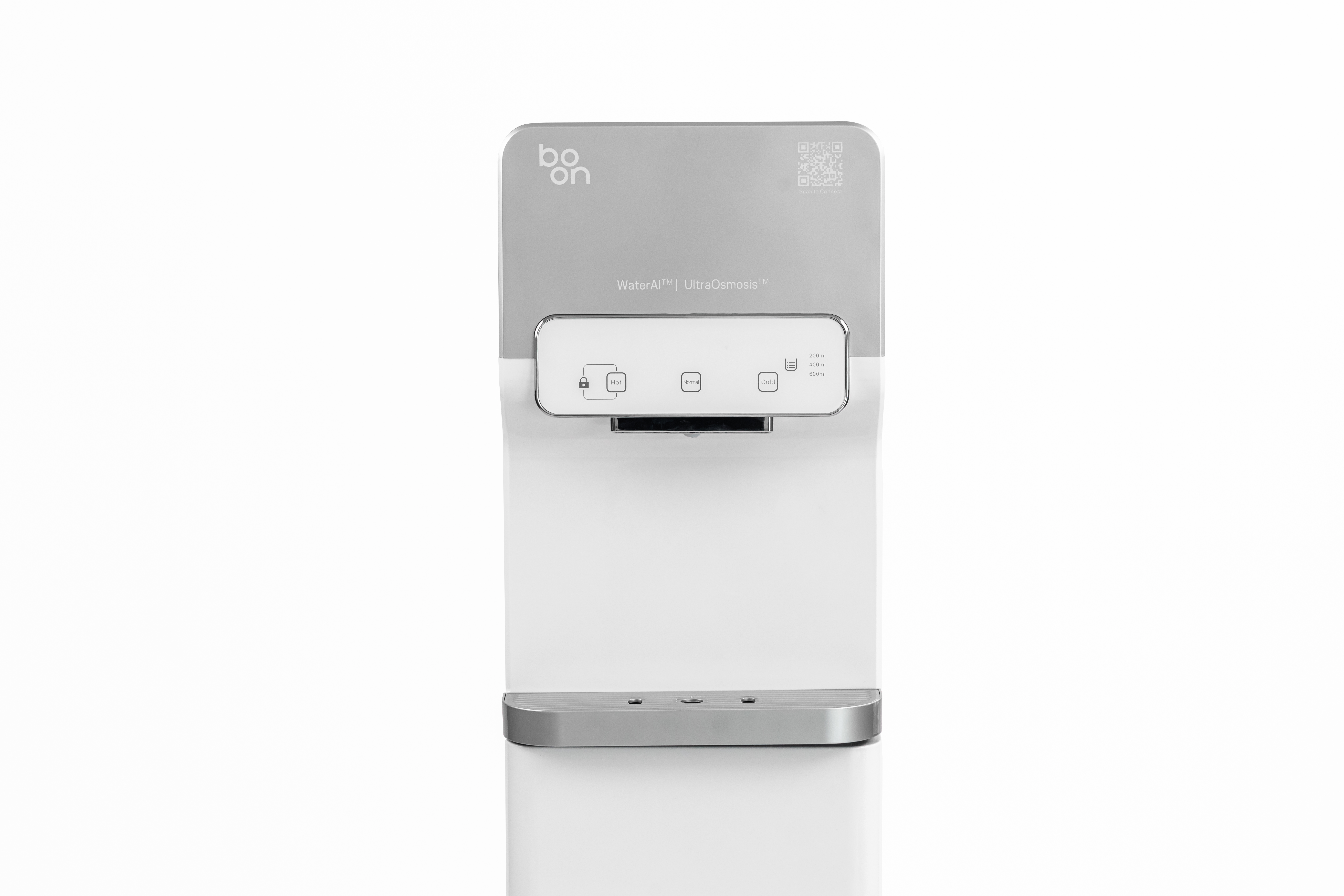
This is where WaterAI changes the picture. The app shows input and output water quality and filter health in real time, so the property and the service team can see exactly when attention is due, instead of waiting for a taste complaint or a failed test. That visibility is what turns maintenance from reactive into planned. WaterAI won the iF Design Award 2026.
India’s drinking-water standard, BIS IS 10500, sets the acceptable limit for TDS at 500 mg/L and total hardness at 200 mg/L, with fluoride at 1.0, arsenic at 0.01 and nitrate at 45 mg/L. A well-configured commercial system is built to keep output comfortably within these limits, and monitoring confirms it stays there day after day.
Why Hotels Choose Boon
Boon already serves more than 400 hotels and over 4,000 organisations worldwide. It was founded by ex-IIT Kanpur engineers and is backed by the Technology Development Board (Government of India), NITI Aayog and Roca. For a hotel, that track record matters: water is not a category to experiment with on guests.
One Partner, Both Sides of the House
Boon covers the full picture. Boon Refill delivers plastic-free glass-bottle water for rooms, restaurants and events, while Boon Purify handles back-of-house volume at 100 to 2,000 LPH. One partner, one standard of water, front and back.
Technology Built for Difficult Water
The 8-stage UltraOsmosis core combines multi-stage RO, UV and carbon stages with mineral balancing, rated for input up to 2,000 ppm TDS. It is built for the hard, high-TDS source water many Indian properties actually face.
Monitoring and Installation Included
WaterAI gives real-time visibility of input and output quality and filter health. Free professional installation by Boon technicians means the input water is measured and the output verified on site, so your water is matched and confirmed from day one rather than assumed.
Want a water plan sized to your property, covering both glass-bottle guest water and back-of-house volume? Talk to the Boon team.
Frequently Asked Questions
What is the best water solution for a hotel in India?
Most hotels use a combination. A commercial RO plant treats water at the point of entry for the kitchen, laundry and back-of-house volume, while glass-bottle water stations supply guest rooms, restaurants and banquets without single-use plastic. The right mix depends on your room count, restaurant covers and source water. Treating your own supply on site is almost always cheaper per litre than buying packaged water, and it removes the plastic waste entirely, which is why hotels increasingly choose on-site purification over bottled deliveries.
How do I size a commercial water purifier for my hotel?
Start with your peak demand, not your average. Estimate drinking and cooking water by rooms and restaurant covers, then add a margin for banquets and full occupancy. As a rough guide, a small boutique hotel may need a plant around 100 to 250 LPH, a mid-size property 250 to 1,000 LPH, and a large hotel or resort 1,000 to 2,000 LPH. The figure also depends on your source water quality, so a site survey that measures input TDS and contaminants gives the accurate size.
Is glass-bottle water cheaper than buying packaged bottles for hotels?
Over time, yes. Packaged plastic bottles carry a high cost per litre that repeats with every guest, every day. An on-site glass-bottle station purifies your own water and serves it in reusable glass, so the cost per litre is a small fraction of packaged water once the system is in place. It also removes the storage, handling and disposal that plastic bottles create. For a property serving water at scale, the running cost falls sharply while the guest experience improves.
What maintenance does a hotel water purifier need?
A commercial system needs periodic filter and membrane changes, sanitisation of storage and dispensing points, and regular checks on input and output water quality. The frequency depends on your water and your volume. With Boon, the WaterAI app monitors input and output quality and filter health in real time, so the property and the service team can see when attention is due, rather than waiting for a problem. This keeps water consistent and avoids surprises during peak occupancy.
Can a commercial purifier handle hard or high-TDS hotel water?
Yes. Many Indian properties draw on borewell or municipal water that is hard or high in dissolved solids. Boon’s 8-stage UltraOsmosis is rated for input up to 2,000 ppm TDS and combines multi-stage RO, UV and carbon stages with mineral balancing. BIS IS 10500 sets the acceptable TDS limit at 500 mg/L and total hardness at 200 mg/L, and the system is built to bring high-TDS source water within safe, good-tasting limits. A site survey confirms the right configuration for your supply.
Why do hotels choose Boon for water?
Boon already serves more than 400 hotels and over 4,000 organisations worldwide. It was founded by ex-IIT Kanpur engineers and is backed by the Technology Development Board (Government of India), NITI Aayog and Roca. Hotels choose Boon for the combination of commercial RO for volume, glass-bottle stations for plastic-free guest water, WaterAI monitoring for consistency, and free professional installation where technicians measure input water and verify output. It is a single partner for both back-of-house volume and front-of-house guest experience.
Boon for hotels: plastic-free glass-bottle water for rooms and restaurants, commercial RO for kitchen and volume, WaterAI monitoring and free professional installation. One partner, front and back of house.